Posts
From the archives: Aaradhya Tiwari
“If it’s not the real me— If it’s not something I love to do, then it won’t be authentic enough to actually go forward with it.” ~ Aaradhya Tiwari more →
From the archives: Abby Wambaugh
“I’m interested in the kind of laugh you do when you look at things in a new way. Like, you pierce through something, and it’s a new thought people connect to and identify with.” ~ Abby Wambaugh more →
From the archives: Ken Kaus
Ken posts a question every day, and has for years — long enough that it stopped being a habit and became who he is. He and Craig talk about editing turning out to be the easy part, imposter syndrome as the hard part, publishing episodes that aren’t perfect, and how podcasting sharpened the way he… more →
From the archives: Paul Jones
Podcasting looks like a technical pursuit until you notice what it does to the people doing it. Paul Jones talks about imposter syndrome, boundaries, a lifelong pull toward making things, and why the connection a conversation makes is the real work — with a detour through Seth Godin’s “It’s Not About the Chocolate.” more →
From the archives: Ryan Flahive
Ryan Flahive came from publishing, cares about climate change, and isn’t going to build a solar panel. So he asked what his own skills could do — and the answer turned out to be a podcast rather than a book. He and Craig talk about why audio suited the stories, how consistency builds momentum, getting… more →
From the archives: Karen Bailey
Karen Bailey noticed a pattern: the people who think in big pictures need pairing with the ones who actually build the thing — idea makers and idea takers, and neither works alone. She and Craig talk about why she moved from blogging about purpose to podcasting about it, what storytelling does that a statement of… more →
From the archives: Nikki Lerner
Nikki Lerner on the strange shift from addressing thousands to speaking to one imagined listener—how a minister and public speaker found that podcasting’s intimacy demands a different kind of authenticity, and how a coach’s nudge finally got her past perfectionism and into the work. more →
From the archives: Monika Mašanauskaitė and Anna Szalucka
Two classical musicians found they say things together they’d never say alone. Monika Mašanauskaitė and Anna Szalucka talk about what podcasting and vlogging did to their thinking, what a music installation revealed about the young listeners everyone assumed weren’t interested, and how working with someone else turns out to be the shortest route past self-doubt. more →
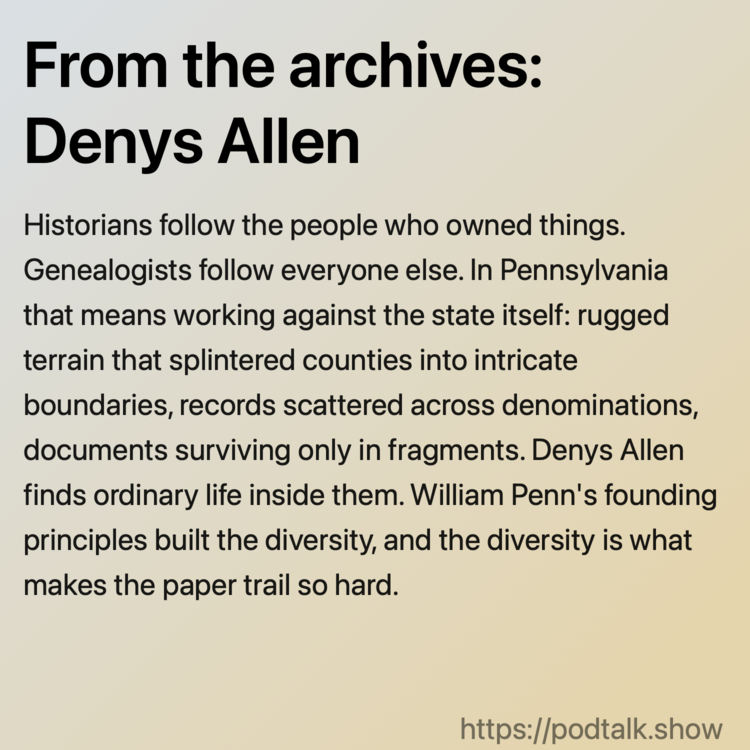
From the archives: Denys Allen
Historians follow the people who owned things. Genealogists follow everyone else. In Pennsylvania that means working against the state itself: rugged terrain that splintered counties into intricate boundaries, records scattered across denominations, documents surviving only in fragments. Denys Allen finds ordinary life inside them. William Penn’s founding principles built the diversity, and the diversity is… more →
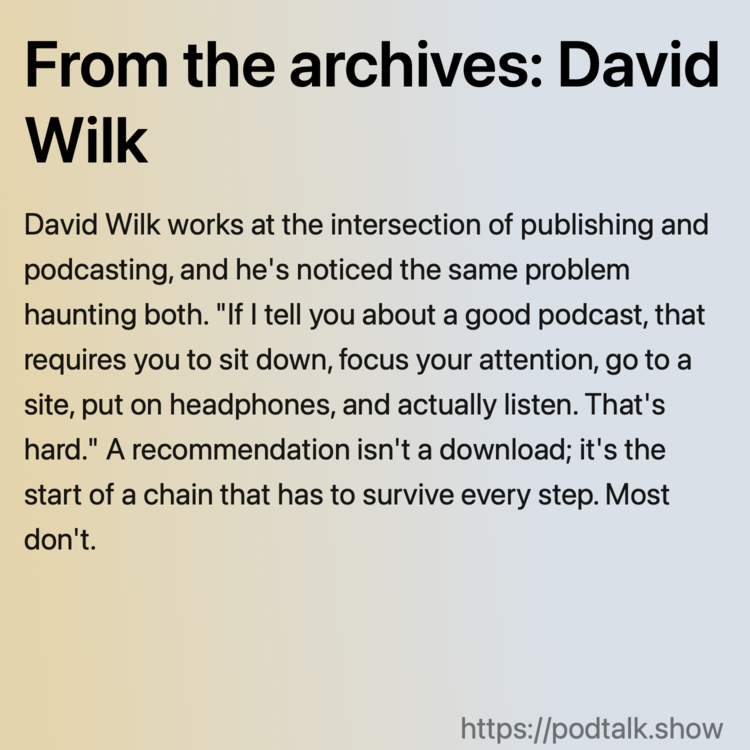
From the archives: David Wilk
David Wilk works at the intersection of publishing and podcasting, and he’s noticed the same problem haunting both. “If I tell you about a good podcast, that requires you to sit down, focus your attention, go to a site, put on headphones, and actually listen. That’s hard.” A recommendation isn’t a download; it’s the start… more →